About the Director

Rigorous developmental science, grounded in real families.

Portrait of Dr. Wonjung Oh

Wonjung Oh, Ph.D.

Associate Professor · Director, CARE Lab

Dr. Oh's research program investigates the development of social and emotional functioning from early childhood through adolescence. She examines how individual characteristics, social interactions, close relationships, and socio-cultural contexts shape developmental pathways — with particular attention to the mechanisms through which these influences operate.

A central aim of her work is understanding pathways toward adaptive functioning (social competence, self-regulation, positive relationship quality) and maladaptive functioning (social withdrawal, anxiety, depression, aggression, dysregulation, dysfunctional relationships) during major normative transitions: the birth of a child or sibling, entry into kindergarten, and the transitions from elementary to middle school, middle to high school, and into adolescence.

Ph.D.Human Development, with Graduate Certificate in Measurement, Statistics & Evaluation — University of Maryland, College Park
Postdoctoral FellowshipDepartment of Psychology & Women and Infants Mental Health Program (Department of Psychiatry), University of Michigan, Ann Arbor
B.S. & M.A.Child and Family Studies, Yonsei University, Seoul, South Korea

Dr. Wonjung Oh · Department of Human Development and Family Sciences, College of Health & Human Sciences, Texas Tech University

  • CHILD
  • ADOLESCENT
  • RESILIENCE
  • ECOLOGY

CARE Lab — Child, Adolescent, Resilience, and Ecology Lab · Dr. Wonjung Oh · Texas Tech University

We study social and emotional development from early childhood through adolescence — asking not only how, but why individual characteristics, close relationships, and socio-cultural contexts become sources of risk or resilience across life's major transitions.

Research

Five questions drive everything we do.

The lab integrates biosocial characteristics of children, parents, and parent–child dyads to identify adaptive and maladaptive developmental pathways — and to inform well-timed, targeted interventions that interrupt dysfunctional cascades and promote positive adjustment over time.

Ongoing Research Projects

Current studies

ONGOING · Y-DEL STUDY

Youth Digital Engagement and Lifestyles Study

Examines how adolescents (ages 10–17) engage with digital technology — including generative AI and chatbot use, media use, online relationships, and social gaming — and how that engagement relates to family and peer relationships, lifestyles, well-being, and mental health.

Digital engagementAdolescentsWell-being
Study details & flyer →
UPCOMING · F-DEL STUDY

Family Digital Engagement and Lifestyle Study

A companion study extending the Y-DEL project to the whole family, examining how family members' (parents' and youth's) digital engagement relates to family dynamics, parenting practices, and adolescent outcomes.

ParentingDigital useFamily dynamics
Study Details

Youth Digital Engagement and Lifestyle (Y-DEL) Study

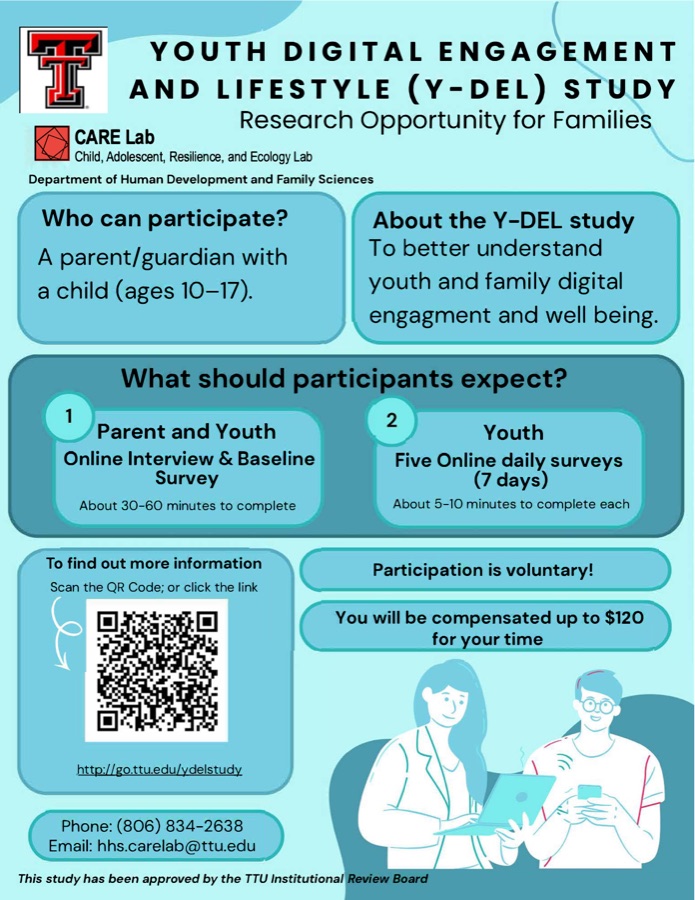
Y-DEL Study recruitment flyer: Youth Digital Engagement and Lifestyle Study, a research opportunity for families with a parent/guardian and child ages 10–17, run by the CARE Lab at Texas Tech University.

Families are invited! Parent–youth dyads (one parent/legal guardian and one youth aged 10–17) are invited to participate in a research study about youth daily digital engagement and emotional well-being. Both the parent/legal guardian and youth must provide consent/assent to participate.

Families may receive up to $120 in electronic gift cards to thank them for their time in the full study.

Part 1 · Baseline Interview & Surveys

Parent/legal guardian and youth complete an online interview and baseline surveys (about 30–60 minutes). Families receive $50 for completing this part.

Part 2 · 7-Day Surveys

Youth complete brief online surveys (about 2–5 minutes each) five times per day over a 7-day period. Families receive $70 for completing this part.

Participation is voluntary, and families may stop at any time for any reason. This study has been approved by the Texas Tech University Human Research Protection Program (Institutional Review Board).

Take the Eligibility Survey ↗ Questions? Contact Dr. Oh at wonjung.oh@ttu.edu (806-834-7736) or the research team at hhs.carelab@ttu.edu (806-834-2638).
SOCIAL–EMOTIONAL DEVELOPMENT

How do social competence and self-regulation take shape — and when do they falter?

We chart developmental change in social behavior and regulatory functioning from early childhood through adolescence, tracing pathways toward both adjustment and difficulties such as withdrawal, anxiety, depression, and aggression.

Social withdrawalSelf-regulationMental health
RELATIONSHIP NETWORKS

What do mothers, fathers, siblings, and best friends each contribute?

Children develop inside a web of close relationships. We study parenting by mothers and fathers, sibling relationships, and peer relationships — including how distinct relationship profiles predict socio-emotional functioning.

ParentingSiblingsPeers & friendship
RISK & RESILIENCE IN TRANSITION

Why do the same transitions derail some children and strengthen others?

From perinatal and postpartum transitions to the birth of a sibling, school readiness, and school transitions, we identify what makes normative change a source of risk — or of resilience — for children and families.

Birth of a siblingSchool transitionsPostpartum
CULTURE & CONTEXT

Which developmental processes are culturally specific — and which are shared?

Through cross-cultural collaborations spanning ten countries, we examine race, ethnicity, and cultural context in social-emotional development, testing where mechanisms diverge and where they hold across societies.

Cross-culturalRace & ethnicity10-country studies
METHODOLOGICAL INNOVATION

Development is dynamic — our methods have to be, too.

The lab applies longitudinal, multi-level, and innovative quantitative approaches — trajectory modeling, multiple-group factor analysis alignment, dynamic dyadic methods — alongside direct observational methods, so the analysis matches the complexity of real developmental change.

Longitudinal modelingMulti-level analysisObservational methodsDynamic approaches
Publications

Selected work.

🎓 Jump to Student Conference Presentations
Google Scholar ↗
  • 2025

    Song, S., Oh, W., Li, T., Wang, Z., & Niehuis, S.

    Dyadic maternal and paternal coparenting change across childhood and adolescent behavioral problems

    Journal of Child and Family Studies, 34(12), 3211–3227

  • 2025

    Sette, S., Coplan, R. J., Ooi, L. L., Oh, W., … & Bowker, J. C.

    Measurement invariance of the Straightforwardly-Worded Social Interaction Anxiety Scale and associations with life satisfaction among emerging adults attending university in 10 countries

    Journal of Anxiety Disorders, 116, 103092

  • 2025

    Neugebauer, C., Oh, W., & Mastergeorge, A. M.

    Patterns of proximity and maternal–infant engagement in a neonatal intensive care unit

    Infant Mental Health Journal, 46(1), 30–45

  • 2024

    Armer, J. S., Oh, W., Davis, M., Issa, M., Sexton, M. B., & Muzik, M.

    Post-traumatic change and resilience after childhood maltreatment: Impacts on maternal mental health over the postpartum period

    Journal of Affective Disorders

  • 2023

    Volling, B. L., Oh, W., Gonzalez, R., Bader, L., & Tan, L.

    Changes in children's attachment security to mother and father after the birth of a sibling: Risk and resilience in the family

    Development and Psychopathology, 35(3), 1404–1420

  • 2023

    Bowker, J. C., Sette, S., Ooi, L. L., Oh, W., … & Coplan, R. J.

    Cross-cultural measurement of social withdrawal motivations across 10 countries using multiple-group factor analysis alignment

    International Journal of Behavioral Development, 47(2), 190–198

  • 2022

    Oh, W., Kim, H., Park, S., Mastergeorge, A. M., & Roggman, L.

    Maternal and paternal insensitivity, adaptive engagement, and school readiness skills among economically disadvantaged children: A dynamic approach

    Early Childhood Research Quarterly, 58, 220–230

  • 2016

    Oh, W., Muzik, M., McGinnis, E., Hamilton, L., Menke, R., & Rosenblum, K. L.

    Comorbid trajectories of postpartum depression and PTSD among mothers with childhood trauma history: Course, predictors, processes and child adjustment

    Journal of Affective Disorders, 200, 133–141

  • 2015

    Oh, W., Volling, B. L., & Gonzalez, R.

    Trajectories of children's social interactions with their infant sibling in the first year: A multidimensional approach

    Journal of Family Psychology, 29(1), 119–129

  • 2008

    Oh, W., Rubin, K. H., Bowker, J. W., Booth-LaForce, C. L., Rose-Krasnor, L., & Laursen, B.

    Trajectories of social withdrawal from middle childhood to early adolescence

    Journal of Abnormal Child Psychology, 36(4), 553–566

  • —
    Conference Presentation

    Lab student presentations

    Details forthcoming

    Student conference presentations will be listed here.

* denotes student collaborator. For the complete record, see Google Scholar.

People

The people behind the work.

Faculty

Portrait of Dr. Wonjung Oh

Wonjung Oh, Ph.D.

Director of CARE Lab

Associate Professor of Human Development and Family Sciences, Texas Tech University

Dr. Oh's research explores how children and adolescents develop socially and emotionally—from early childhood through adolescence. She is particularly interested in how and why individual characteristics, relationships, and broader social and cultural environments shape young people's developmental pathways. Her work examines what helps young people thrive—including social competence, self-regulation, and healthy relationships—as well as what can contribute to challenges, such as social withdrawal, anxiety, depression, aggression, emotion dysregulation, and relationship difficulties. A key focus is understanding how these pathways unfold during important developmental transitions, such as the birth of a child or sibling, becoming a parent, starting kindergarten, transitioning from elementary to middle school and high school, and entering adolescence.

wonjung.oh@ttu.edu

Graduate Students

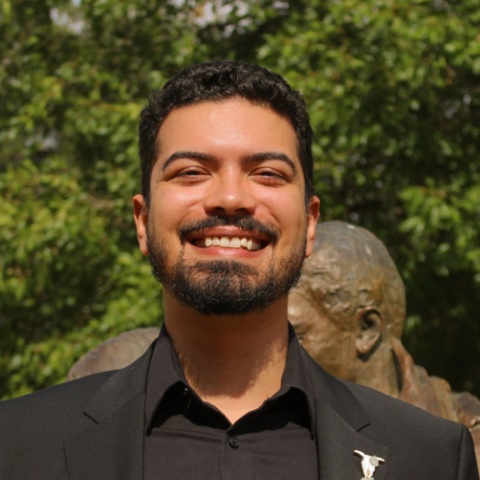
Portrait of Carlos A. Silvera

Carlos A. Silvera

Graduate Lab Coordinator

Carlos A. Silvera is a Ph.D. student in Human Development and Family Sciences at Texas Tech University and a graduate researcher in the CARE Lab. His research focuses on health, development, and well-being, with particular interests in how social, behavioral, and contextual factors shape health outcomes among historically underserved populations. In the CARE Lab, Carlos supports research coordination, student mentorship, and projects examining youth and family well-being in an increasingly digital world. His long-term goal is to become an independent researcher at an academic medical center, developing research that bridges behavioral science, clinical care, and health equity.

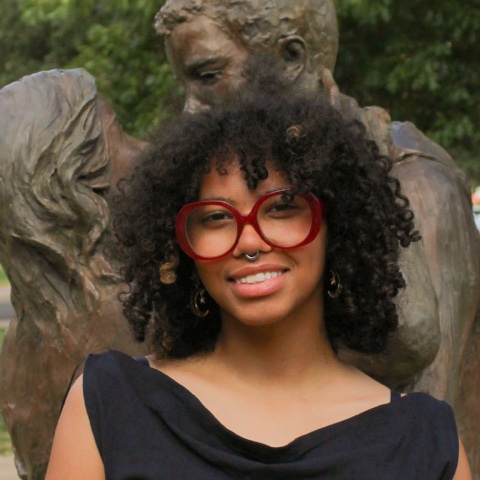
Portrait of MD Khalid Hasan

MD Khalid Hasan

PhD Student

Md Khalid Hasan is a PhD student in Human Development and Family Sciences at Texas Tech University and a Researcher and Mentor in the CARE Lab. His work focuses on children's and adolescents' mental health and well-being, with an emphasis on how disasters and extreme climate shape developmental trajectories. Outside the lab, he enjoys poetry, nature, and the open sky.

Undergraduate Researchers

Portrait of Emma Fernández

Emma Fernández

Undergraduate Lab Coordinator

Emma Fernandez is a junior psychology major at Texas Tech University and the Undergraduate Lab Coordinator for Dr. Wonjung Oh's Child, Adolescent, Resilience, and Ecology (CARE) Lab. She works on the Youth Digital Engagement and Lifestyle (Y-DEL) Study, helping progress the ongoing efforts to understand youth digital lifestyle. Her work in the CARE Lab involves task delegation and REDCap survey design. Her research interests are veterans and their integration into the civilian world after combat, sexual trauma, and trauma/PTSD, along with adolescents' development with the continuing integration of technology into their lives. She plans to attend graduate school and eventually become a licensed therapist.

Portrait of Giana Matheny

Giana Matheny

Undergraduate Research Assistant

Giana Matheny is a senior at Texas Tech University majoring in Psychology. In fall 2026, she is eager to contribute to the CARE Lab as an undergraduate assistant member. Her research interests include understanding how psychological research can support children and adolescents in educational settings. Through her involvement in the lab, Giana hopes to gain valuable research experience and further develop her understanding of child development, mental health, and student well-being. After completing her undergraduate degree, Giana plans to attend graduate school to pursue a career as a school psychologist. She is passionate about working with students and hopes to help promote their academic, social, and emotional development. Giana looks forward to continuing to grow as a researcher and future school psychologist through her experiences at Texas Tech University.

Portrait of Cailyn Green

Cailyn Green

Undergraduate Research Assistant

Cailyn is a senior at Texas Tech University pursuing a degree in Human Development and Family Sciences with a minor in Community, Family, and Addiction Sciences. In the CARE Lab, she will primarily assist with participant consent calls and support administrative and research-related tasks. Her interests include research coordination, administrative support, and helping connect individuals and families with resources. She hopes to apply her academic and research experience to a career that combines research, organization, and advocacy.

Alumni

Profiles updating — check back soon.

LC

Lillie Cobb

Alum

Details forthcoming.

Collaborators & Mentors

"I have amazing mentors. Kenneth H. Rubin, Natasha Cabrera, and Greg Hancock were exceptional and dedicated graduate mentors at the University of Maryland, College Park. Brenda Volling, Richard Gonzalez, and Maria Muzik were amazing mentors during my postdoctoral fellowship at the University of Michigan, Ann Arbor. The collaborators listed here continue to help me grow as a scholar." — Dr. Oh

Cathryn Booth-LaForce · Julie Bowker · Xinyin Chen · Robert Coplan · Ebony Dashiell-Aje · Pamela Davis-Kean · Carolyn J. Dayton · Richard Gonzalez · Sybil Hart · Brett Laursen · Kristina McDonald · Maria Muzik · Linda Rose-Krasnor · Kenneth H. Rubin · Prachi Shah · Brenda Volling · Tianyi Yu, and colleagues worldwide

News

Recent updates.

  • Recruiting

    CARE Lab is recruiting Ph.D. students for Fall 2027

    Dr. Oh is currently accepting graduate students through the HDFS doctoral program at Texas Tech University. Prospective students interested in social-emotional development, family transitions, or quantitative methods are encouraged to reach out.

  • Publication

    New paper in the Journal of Affective Disorders

    With colleagues at the University of Michigan, the lab examined post-traumatic change and resilience after childhood maltreatment and their impacts on maternal mental health across the postpartum period.

  • Publication

    Attachment after the birth of a sibling — Development and Psychopathology

    New findings on how children's attachment security to mother and father changes after a sibling's birth, identifying risk and resilience within the family system.

  • Publication

    Ten-country study of social withdrawal motivations

    A cross-cultural measurement study spanning 10 countries, published in the International Journal of Behavioral Development using multiple-group factor analysis alignment.

  • Award

    Open Access Publication Initiative Award

    Oh et al. (2021), published in Child Development, received the Open Access Publication Initiative Award from the Office of the Vice President for Research at Texas Tech University.

Join CARE Lab

Do work that changes how children are understood.

The lab welcomes curious, rigorous people at every stage — from undergraduates gaining their first research experience to doctoral students building a program of research.

Prospective Ph.D. Students

Join through the Human Development & Family Sciences doctoral program. Ideal fits are interested in social-emotional development, family and school transitions, or advanced quantitative methods.

Now accepting students for Fall 2027 →

Undergraduate Researchers

Gain hands-on experience with research involving children, youth, and families, and the multi-faceted dynamics of daily life and ecology.

Applications open year-round →

Collaborators

The lab collaborates across institutions and countries — from cross-cultural measurement studies to longitudinal family research. New partnerships are always welcome.

Start a conversation →

Email Dr. Oh → HDFS Ph.D. Program ↗ Include a brief note on your interests and experience.
Call for Applications

Call for Undergraduate Research Assistants

The Child, Adolescent, Resilience, and Ecology (CARE) Lab, directed by Dr. Wonjung Oh, is recruiting undergraduate research assistants to join our ongoing Youth Digital Engagement and Lifestyles (Y-DEL) Study and upcoming Family Digital Engagement and Lifestyle (F-DEL) Study.

These projects focus on adolescents (ages 10–17) and their parents, examining how digital engagement — including generative AI and chatbot use, media use, online relationships, social gaming, and parental digital use — relates to family and peer relationships, lifestyles, well-being, and mental health.

Undergraduate research assistants will have opportunities to:

  • Gain hands-on experience with data collection and processing
  • Assist with online survey development and data management
  • Conduct literature reviews on digital engagement and child/adolescent development
  • Participate in lab meetings and research presentations at conferences

This opportunity is ideal for students interested in human development, psychology, family sciences, or related fields, particularly those considering graduate school or careers in research.

Please submit the following:

If you have any questions, please contact our Graduate Lab Coordinator Carlos A. Silvera (csilvera@ttu.edu) or Director Dr. Wonjung Oh (wonjung.oh@ttu.edu).

Sincerely,
Dr. Wonjung Oh, Ph.D.
Associate Professor, Human Development and Family Sciences
Director, Child, Adolescent, Resilience, and Ecology (CARE) Lab
College of Health & Human Sciences, Texas Tech University

Contact

Get in touch.

Visit the lab

Texas Tech University
College of Health & Human Sciences
P.O. Box 41230
Lubbock, TX 79409-1230
Open in Google Maps ↗